Here's an uncomfortable interview question: explain what React Router actually does when you click a link.
Not the API. The mechanics.
Most senior frontend engineers, people who have shipped SPAs for years, get vague around sentence two. They mention pushState, maybe a popstate listener. Then the hand-waving starts.
Nobody should be embarrassed by that. The vagueness is a symptom of something the ecosystem has quietly agreed not to talk about: client-side routing has never been a real browser capability, just a pile of workarounds stacked on an API that was never designed for it. Ian Hickson, the former HTML spec editor, calls pushState() his "favourite mistake." The person who shipped the foundation of every SPA router considers it a mistake.
That era just ended. The Navigation API reached Baseline Newly Available in January 2026, after Safari 26.2 shipped support on December 12, 2025, and Firefox 147 closed the loop on January 13, 2026. For the first time, routing is a platform primitive in Chrome, Edge, Firefox, and Safari.
Which brings me to the stance I'll defend: even if you never remove React Router from a single project, you need to understand this API. Routers will be rebuilt on top of it, and the "design a client-side router" interview answer just changed. For small apps and internal tools, the correct number of routing dependencies is now zero.
What your router has been papering over for twelve years
To appreciate the fix, you have to look honestly at the hack. This is the skeleton of every History-API-based router ever written, including the one inside whatever framework you use today:
// The classic SPA router: looks reasonable, held together with tape.

// Step 1: hijack every link click in the document
document.addEventListener('click', (e) => {
  const link = e.target.closest('a');
  if (!link) return;

  // Step 2: hand-roll the guard list, and pray it's complete
  if (
    link.origin !== location.origin ||   // external link
    link.hasAttribute('download') ||     // file download
    link.target === '_blank' ||          // new tab
    e.metaKey || e.ctrlKey ||            // cmd/ctrl+click
    e.shiftKey || e.button !== 0         // shift+click, middle click
  ) {
    return; // let the browser handle it... hopefully
  }

  e.preventDefault();
  history.pushState({}, '', link.href);  // Step 3: lie to the URL bar
  renderRoute(link.pathname);            // Step 4: render manually
  window.scrollTo(0, 0);                 // Step 5: fake scroll behavior
});

// Step 6: a COMPLETELY SEPARATE code path for back/forward
window.addEventListener('popstate', () => {
  renderRoute(location.pathname);
  // Scroll restoration? Focus management? You're on your own.
});
Count the failure modes. The guard list is famously never complete; every production router has accumulated edge cases for years. The forward path (clicks) and the backward path (popstate) are two different code paths that must agree but have no mechanism forcing them to. Scroll restoration is your problem. Focus management for screen readers is your problem too, and almost nobody does it.
And underneath it all, the History API itself is broken in documented ways: it cannot detect all the things that trigger navigations, it gives you no way to read the full history stack or touch any entry other than the current one, and popstate behaves inconsistently, most famously by not firing when you call pushState or replaceState yourself. The API's write path and its event path don't even know about each other.
What you built on was never a foundation, just a coincidence that mostly works.
One event now sees every navigation
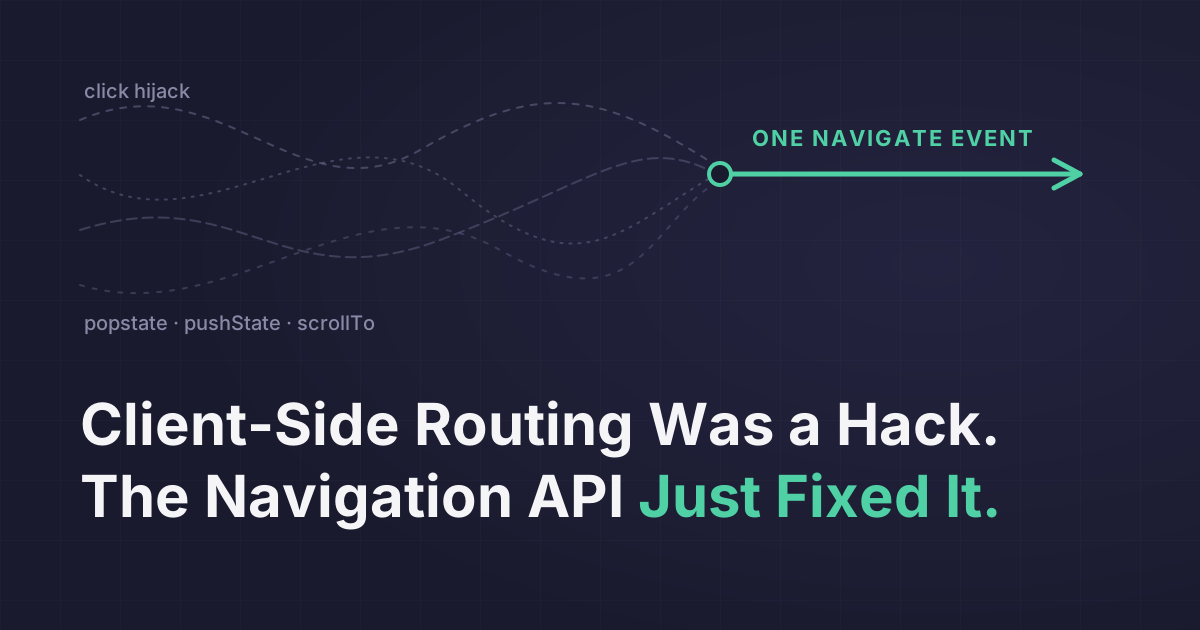
The Navigation API's core idea is almost insultingly simple: a single navigate event on window.navigation that fires for all navigation types: link clicks, form submissions, back and forward buttons, programmatic calls. One listener, one code path.
The same router, rewritten:
navigation.addEventListener('navigate', (event) => {
  // The browser tells you what it would refuse to let you intercept
  // (cross-origin links, downloads) instead of you guessing.
  if (!event.canIntercept || event.downloadRequest !== null) return;
  if (event.hashChange) return; // same-page anchor, let it be

  const url = new URL(event.destination.url);

  event.intercept({
    async handler() {
      await renderRoute(url.pathname);
    },
  });
});
That's the whole thing. There is no click hijacking and no preventDefault guard list. You never call pushState, because the browser updates the URL bar and the history stack itself. There is no separate popstate handler either, since back/forward fires the same navigate event through the same listener. Scroll and focus restoration are handled by the browser by default, with scroll: 'manual' and focusReset: 'manual' available when you need control.
Jake Archibald summed up the milestone: "The web now has sensible, low-level routing for navigations." The keyword is low-level: not a router, but the primitive routers should have had in 2012.
The event tells you everything the click listener had to guess
The NavigateEvent carries the context your old guard list was reverse-engineering from DOM state:
canIntercept: the browser's verdict on whether this navigation is yours to handle (cross-origin and cross-document traversals are not)destination.url: where the user is goinghashChange: true for same-page fragment navigationsdownloadRequest: non-null when the link has a download attributeformData: non-null for POST form submissions (more on this below)navigationType: one of"reload","push","replace", or"traverse"signal: an AbortSignal that fires if the user navigates away mid-load, so you can cancel in-flight fetches for free
That last one deserves a pause. The user clicks a link, your data fetch starts, the user clicks a different link. With the History API you hand-rolled cancellation. More honestly, you didn't, and stale responses raced fresh ones. Now you pass event.signal to fetch and the platform cancels for you.
And the history stack is finally readable. navigation.entries() returns a snapshot of the session history; each entry has a stable key, a url, an index, and getState(). One sharp edge worth knowing: getState() returns a copy. Mutating it does nothing; you persist state through navigation.navigate() or navigation.updateCurrentEntry(). That will bite someone on your team; better it's not you.
The 50-line router, and why it's an interview answer now
"Design a client-side router" is a classic senior frontend interview question. Until this year, a strong answer was a tour of the History API's traps. Now a strong answer is this:
// router.js: no dependencies, production-grade semantics
const routes = [
  { pattern: new URLPattern({ pathname: '/' }), view: renderDashboard },
  { pattern: new URLPattern({ pathname: '/invoices/:id' }), view: renderInvoice },
  { pattern: new URLPattern({ pathname: '/settings' }), view: renderSettings },
];

function matchRoute(url) {
  for (const route of routes) {
    const match = route.pattern.exec(url);
    if (match) return { ...route, params: match.pathname.groups };
  }
  return null;
}

if ('navigation' in window) {
  navigation.addEventListener('navigate', (event) => {
    if (!event.canIntercept || event.hashChange || event.downloadRequest !== null) {
      return;
    }

    const route = matchRoute(event.destination.url);
    if (!route) return; // unmatched: let the browser do a full navigation

    event.intercept({
      async handler() {
        const data = await fetchRouteData(route, { signal: event.signal });
        route.view(route.params, data);
      },
    });
  });

  // One global place for pending UI and errors, no per-route plumbing
  navigation.addEventListener('navigatesuccess', () => hideLoadingBar());
  navigation.addEventListener('navigateerror', (e) => {
    hideLoadingBar();
    showErrorToast(e.message);
  });
}
// No 'navigation' in window? Do nothing. Links full-page navigate.
// Your app still works. That's the fallback, and it's a feature.
Notice what the navigatesuccess and navigateerror events buy you: the intercept handler returns a promise, and the platform routes its outcome to two global events. Your loading bar and your error toasts live in one place and cover every navigation, including back/forward. With the History API, "did the navigation finish?" wasn't even a question the platform could express.
Programmatic navigation got the same upgrade. navigation.navigate(url), navigation.back(), navigation.forward(), navigation.reload(), and navigation.traverseTo(key) all return two promises: committed (the URL changed) and finished (your handler completed). The difference between those two moments is exactly the thing SPA developers have faked with loading state for a decade.
Async navigations: where the defaults are smarter than your code
First, the wrong way, which has shipped to production thousands of times:
// Looks fine, scrolls at the wrong time.
event.intercept({
  async handler() {
    renderSkeleton();
    const invoice = await fetchInvoice(params.id, { signal: event.signal });
    renderInvoice(invoice);
    window.scrollTo(0, 0); // wrong on back/forward, where the user expects their old position
  },
});
Manual scrollTo(0, 0) treats every navigation the same. But a back navigation should restore the user's previous scroll position, and a fresh push should go to the top, or to the fragment if the URL has one. Your code knows none of this. The browser knows all of it.
The right way is to tell the browser when, not where:
event.intercept({
  scroll: 'manual',      // don't scroll until I say the content exists
  focusReset: 'auto',    // move focus appropriately after navigation (a11y win)
  async handler() {
    renderSkeleton();
    const invoice = await fetchInvoice(params.id, { signal: event.signal });
    renderInvoice(invoice);
    event.scroll();      // now scroll, correctly for the navigation type
  },
});
event.scroll() does the right thing for the navigation type: restores position on traversals, goes to top or fragment on pushes. Chrome's docs note the browser may even attempt the scroll multiple times asynchronously to handle late-arriving content. And focusReset handles the post-navigation focus move that screen-reader users need and almost no hand-rolled router ever implemented.
This is my second stance, and it's the one people will push back on: the browser's navigation defaults are now better than your custom code. The scroll logic you wrote is worse than event.scroll(). The focus management you didn't write is worse than focusReset: 'auto'. The era of being proud of your bespoke scroll restoration is over.
The navigation the History API literally could not see
Form submissions are the cleanest proof that the old model was broken. A same-document form POST was invisible to the History API, because there was nothing to listen to. Routers dealt with this by ignoring it: you wired onSubmit, called preventDefault, and did everything by hand, outside the routing system entirely.
The navigate event sees it:
navigation.addEventListener('navigate', (event) => {
  if (event.formData && event.canIntercept) {
    event.intercept({
      async handler() {
        const response = await fetch(event.destination.url, {
          method: 'POST',
          body: event.formData,
          signal: event.signal,
        });
        renderResult(await response.json());
      },
    });
  }
});
A plain HTML form element with an action attribute, zero JavaScript on the form itself, progressively enhanced into an SPA interaction by the router. If JavaScript fails to load, the form still posts. This is the architecture progressive-enhancement people have argued for since forever. It just needed the platform to make it possible.
And if you want app-like polish, the API composes with View Transitions: wrap your handler's render in document.startViewTransition() and you get animated route changes, viable cross-browser now. Safari 26.2 also shipped document.activeViewTransition, and the :active-view-transition pseudo-class reached Baseline in the same January 2026 window.
So should you use it today?
Honest answer, in three tiers.
For small apps and internal tools: yes, now. The same goes for browser extensions. Feature-detect with 'navigation' in window, fall back to full page loads, and ship the 50-line router. Full page loads are a perfectly good fallback, which is what makes this adoption path safe in a way most new APIs aren't.
For production apps on React Router or TanStack Router: not yet, but watch closely. Both have open discussions about adopting the Navigation API and neither has shipped an integration. When they do, your router's flakiest behaviors (scroll restoration, navigation cancellation, the back/forward edge cases) get replaced by platform code. Understanding the primitive now means you'll understand your router's changelog later.
Either way, know the limits before you commit. Baseline Newly Available means it works everywhere current, not everywhere your users are, so check your support matrix. Safari's implementation currently lacks precommitHandler, the hook for running work before the URL changes. Cross-origin navigations and cross-document traversals can't be intercepted. User-initiated back/forward can't be blocked, though the event still fires, which is genuinely useful for analytics. No navigate event fires on the initial page load. The API is single-frame. And you still can't programmatically rearrange or delete history entries (the spec repo openly tracks the unsolved "temporary modal entry" case).
None of those are reasons to ignore it; they just trace the actual contour of the tool, which is more than the History API ever gave you. Its limits were undocumented, discovered one production bug at a time.
The router was never the interesting part
For twelve years, the hardest parts of frontend routing (seeing every navigation, knowing when one finished, restoring scroll and focus correctly) were impossible to do properly, so we ranked routers by how well they faked it.
That competition is over. The faking is now the platform's job, and the platform does it better.
So, a challenge: before you reach for a router on your next side project or internal tool, write the navigate listener yourself. Fifty lines. You'll understand more about how the web actually navigates than years of router configuration taught you, and the next time someone asks what happens when a user clicks a link in an SPA, you won't hand-wave.
You'll just answer.