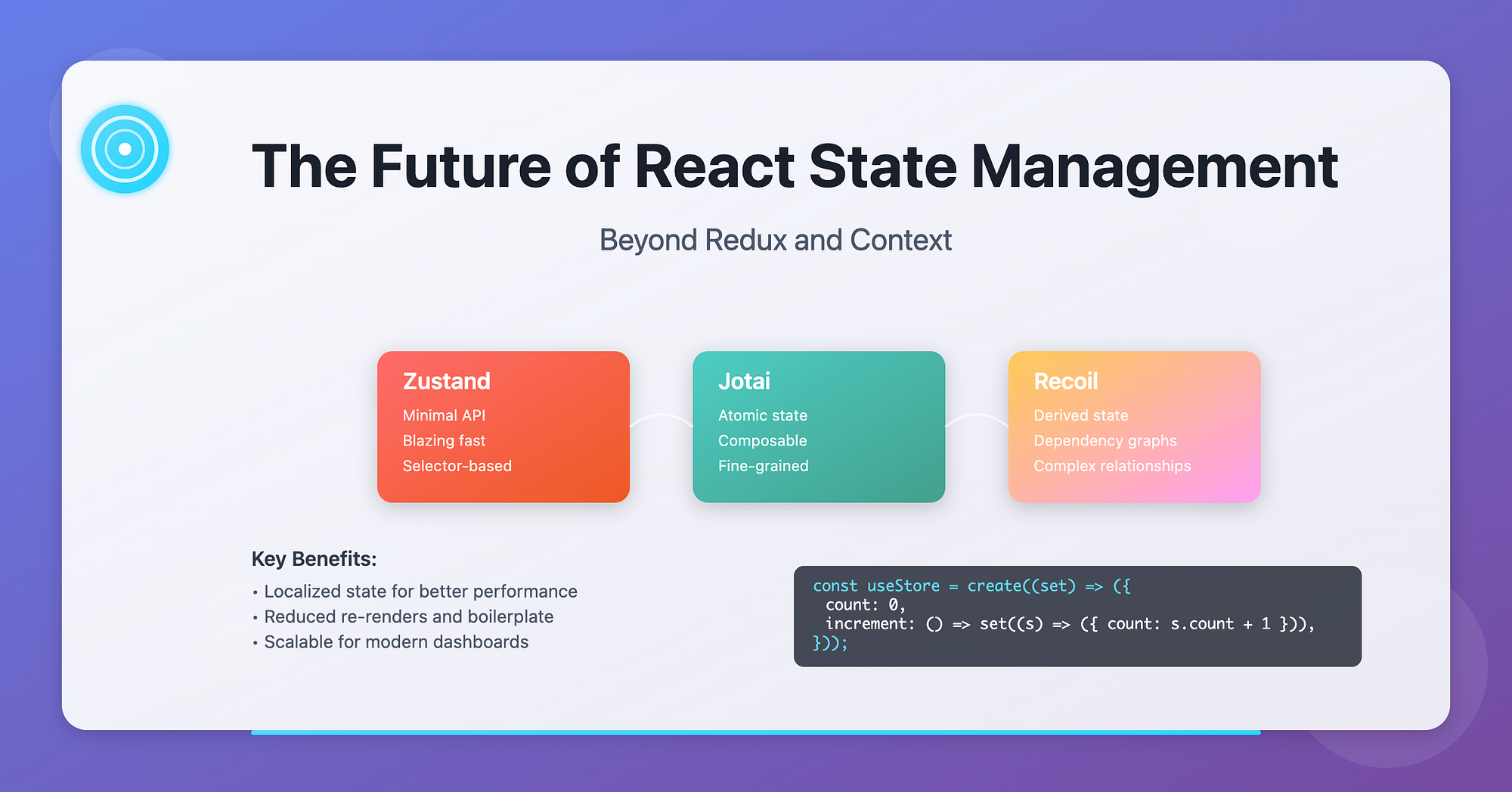
Remember the days when Redux was the default answer to every React state problem? Or when Context API felt like a shiny built-in alternative? Fast-forward to 2025, and the frontend landscape looks very different. Apps are bigger, performance demands are higher, and users expect dashboards that feel instant, even when powered by hundreds of filters and dynamic views.
The truth is: Redux and Context alone can't keep up with the scale of today's applications. The React ecosystem has evolved, and new libraries are pushing boundaries. Let's talk about where state management is heading, and why tools like Zustand, Jotai, Recoil are redefining the future.
The Problem With Old Approaches
Redux gave us structure and predictability. Context made prop-drilling less painful. But in high-performance apps, both show their cracks:
- Boilerplate Hell: Redux reducers, actions, thunks — great in theory, but overwhelming at scale.
- Re-renders Everywhere: Context often triggers unnecessary renders across entire component trees.
- Single-Store Bottlenecks: With all state centralized, performance tanks when multiple views compete for updates.
These limitations matter in modern dashboards where you might have:
- Dozens of filters configured by the backend
- Tables with hundreds of dynamic columns
- Users collaborating in real-time across multiple tabs
You need state management that's fast, localized, and scalable.
Enter the New Generation of State Managers
1. Zustand
Minimal API, blazing-fast updates. Zustand's key win is its selector-based subscriptions, meaning components only re-render when the slice of state they care about changes.
import { create } from "zustand";

const useStore = create((set) => ({
  count: 0,
  increment: () => set((s) => ({ count: s.count + 1 })),
}));

function Counter() {
  const count = useStore((s) => s.count);
  return (
    <button onClick={() => useStore.getState().increment()}>{count}</button>
  );
}
This is the opposite of Context's "everything re-renders" problem.
2. Jotai
Think of Jotai as state as atoms. Each piece of state is independent and composable. Perfect for apps that need fine-grained reactivity without the overhead of a global store.
import { atom, useAtom } from "jotai";

const countAtom = atom(0);
const multiplierAtom = atom(2);
const multipliedAtom = atom(
  (get) => get(countAtom) * get(multiplierAtom)
);

function Counter() {
  const [count, setCount] = useAtom(countAtom);
  const [multiplier, setMultiplier] = useAtom(multiplierAtom);
  const [multiplied] = useAtom(multipliedAtom);
  return (
    <div>
      <p>Count: {count}</p>
      <p>Multiplier: {multiplier}</p>
      <p>Result: {multiplied}</p>
      <button onClick={() => setCount((c) => c + 1)}>+ Count</button>
      <button onClick={() => setMultiplier((m) => m + 1)}>+ Multiplier</button>
    </div>
  );
}
Here's why this is powerful:
- Atoms can depend on other atoms, making state composable instead of centralized.
- Only the components that use a particular atom re-render when it changes.
- You can build entire state graphs declaratively, without boilerplate reducers.
This makes Jotai especially useful for dashboards, forms, and apps where multiple pieces of state interact dynamically.
3. Recoil
Recoil introduced derived state and dependency graphs to React. Components only update when their dependencies change, making it great for complex data relationships.
import { atom, selector, useRecoilState, useRecoilValue } from "recoil";

const countState = atom({ key: "count", default: 0 });
const doubleCount = selector({
  key: "doubleCount",
  get: ({ get }) => get(countState) * 2,
});

function Counter() {
  const [count, setCount] = useRecoilState(countState);
  const doubled = useRecoilValue(doubleCount);
  return (
    <div>
      <p>Count: {count}</p>
      <p>Double: {doubled}</p>
      <button onClick={() => setCount((c) => c + 1)}>+</button>
    </div>
  );
}
It feels like React hooks on steroids.
The Big Picture: What's Next?
State management is moving away from monolithic stores and towards granular, localized, and composable state.
The future looks like this:
- Localized State for Performance: Zustand, Jotai
- Derived State for Complex Apps: Recoil's selector model
- Hybrid Architectures: Combining server-side caching (React Query, SWR) with lightweight client stores
- Scalability Patterns: Tab isolation, batched updates, and subscription-based rendering
Final Thoughts
Redux and Context aren't going away tomorrow. They're still good for certain use cases. But in 2025, the cutting edge of React state management is fast, modular, and localized.
If you're building dashboards, data-heavy apps, or collaborative UIs then don't just reach for Redux by default. Explore Zustand, Jotai, and Recoil.
Because the future of React isn't about writing more reducers. It's about building scalable, snappy experiences that users love.