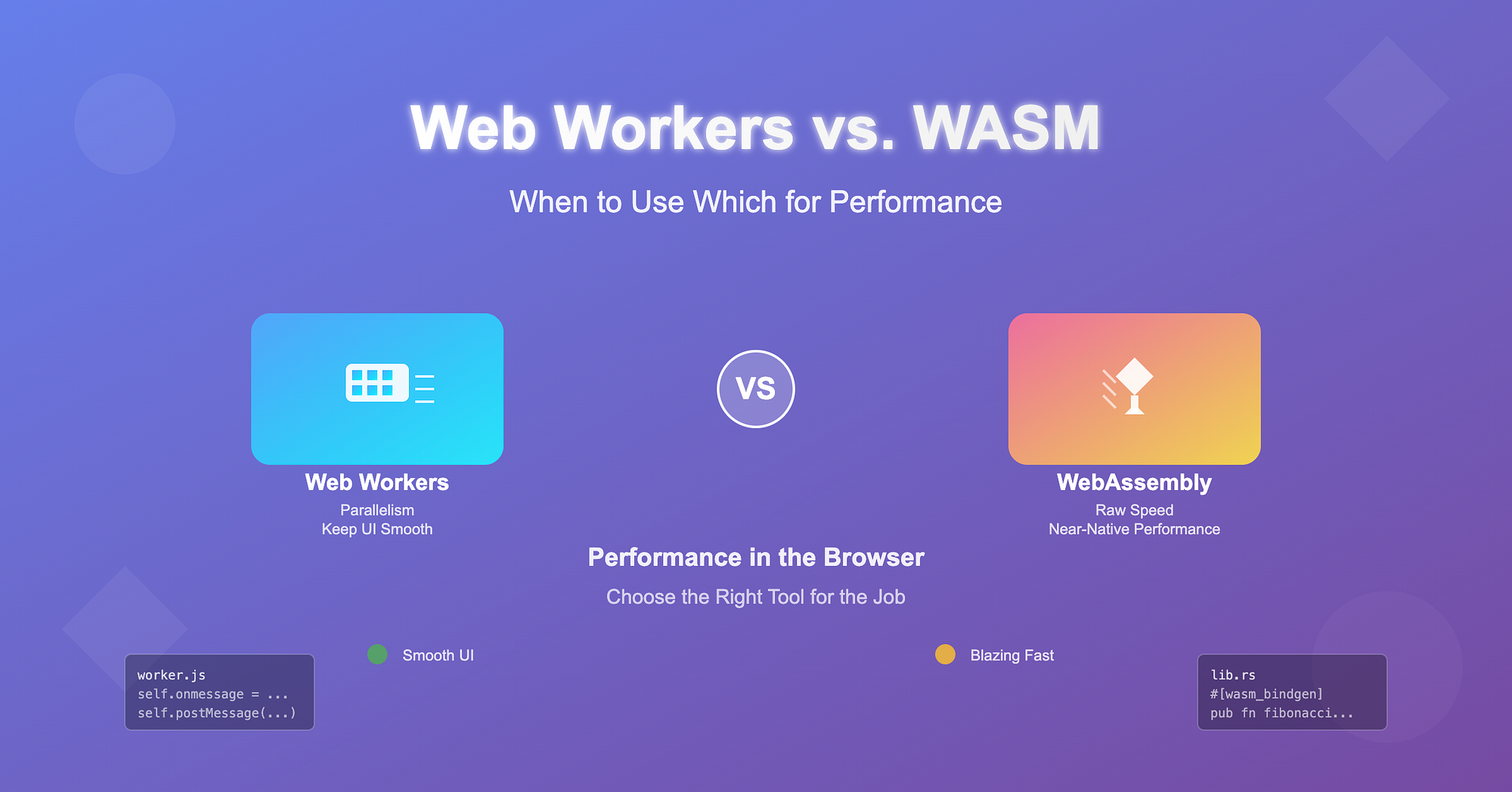
Remember that time your dashboard froze while crunching through thousands of rows, or your fancy animation lagged because some data processing hogged the thread? We've all been there. In my last post, we talked about Web Workers as the secret weapon to free your UI from heavy lifting. But there's another player in the performance game that developers are buzzing about in 2025: WebAssembly (WASM).
Both Web Workers and WASM promise speed, but they solve very different problems. The tricky part? Knowing when to use which.
The Core Difference
- Web Workers = Move your heavy JavaScript tasks to another thread so the main UI stays smooth.
- WebAssembly (WASM) = Run near-native code in the browser for CPU-intensive calculations.
Think of it like this:
- Workers are about parallelism (don't block the main thread).
- WASM is about raw execution speed (do the work faster).
Web Workers in Action: Keeping the UI Free
Imagine you're parsing a 50MB CSV file in your browser. With vanilla JavaScript, the UI locks up until parsing is done. With a Worker, you move the parsing into a background thread:
// worker.js
self.onmessage = (e) => {
  const rows = e.data.split("\n").map((line) => line.split(","));
  self.postMessage(rows);
};

// main.js
const worker = new Worker("worker.js");
worker.onmessage = (e) => {
  console.log("Rows parsed:", e.data.length);
};
worker.postMessage(csvFileContents);
✅ Smooth scrolling.
✅ User can click around while parsing happens.
✅ Perfect for dashboards, analytics, and data-heavy apps.
WASM in Action: Raw Speed
Now imagine instead of just parsing, you need to run complex financial calculations or process an image filter pixel by pixel. JavaScript can do it — but it'll be slow. WASM lets you run C, C++, or Rust code compiled to the browser for near-native performance.
A simplified example using Rust → WASM:
// lib.rs
#[wasm_bindgen]
pub fn fibonacci(n: u32) -> u32 {
    match n {
        0 => 0,
        1 => 1,
        _ => fibonacci(n - 1) + fibonacci(n - 2),
    }
}
Once compiled to WASM, you can call this in JS:
import init, { fibonacci } from "./pkg/wasm_module.js";

async function run() {
  await init();
  console.log("Fib(40):", fibonacci(40)); // Much faster than JS
}
run();
✅ Blazing-fast execution.
✅ Great for algorithms, simulations, and real-time image/video processing.
The Overlap: Best of Both Worlds
Here's the fun part: you can use WASM inside Web Workers.
That means:
- Run CPU-heavy code in WASM.
- Offload it to a background thread with a Worker.
- Keep the UI smooth and the code fast.
// worker.js
import init, { fibonacci } from "./pkg/wasm_module.js";

self.onmessage = async (e) => {
  await init();
  const result = fibonacci(e.data);
  self.postMessage(result);
};
This combo is how modern apps handle 3D rendering, AI inference in the browser, and large-scale simulations.
When to Use What
Use Web Workers when:
- You're blocking the main thread with heavy but JavaScript-friendly tasks (data parsing, JSON transforms, API batching).
- You need to keep the UI reactive while work happens elsewhere.
Use WASM when:
- You're CPU-bound and need raw speed (math-heavy calculations, image/video/audio processing, cryptography, physics engines).
- You already have optimized C++/Rust libraries you want to run in the browser.
Use Both when:
- You need maximum performance and a smooth UI.
- Example: A photo editor that applies real-time filters (WASM) without blocking user interactions (Workers).
Wrapping Up
Performance in the browser is no longer just about "writing faster JavaScript." It's about picking the right tool:
- Web Workers to keep the UI silky smooth.
- WASM to make heavy computations scream.
- And sometimes, combining both to build truly next-gen apps.
The real secret? Your users don't care if it's Workers or WASM. They care if your app feels instant.
So next time your dashboard lags or your data pipeline struggles, ask yourself: is this about parallelism or raw speed? That answer will guide you to the right choice.